

Motivosity and Bonusly do the same core job: they let employees recognize each other and turn that recognition into rewards. The differences that matter sit elsewhere, in how you buy each tool, what it costs to fund rewards, and what comes with it beyond recognition.
Bonusly is a peer recognition platform where coworkers give each other points from a giving allowance and redeem them for gift cards, donations and other rewards. Motivosity is a recognition and rewards platform that can run on points, dollars or both, with redemption through a marketplace or a company-funded Visa card.
Below, we show where that line falls for your headcount and what each tool costs once rewards are funded.
Motivosity vs Bonusly at a glance
How much do Motivosity and Bonusly cost in 2026?
Bonusly costs $0 for up to 8 users and $50 per user per year on its Team plan with Bizy AI. Motivosity does not publish its rates, but every contract has a $3,000 minimum annual spend. Both bill the rewards budget separately from the software license.
Bonusly plans
Bonusly's subscription documentation, dated September 16, 2026, lists three plans:
- Free: up to 8 users, with peer recognition, pulse checks, 1:1 agendas, Slack and Microsoft Teams, and mobile apps. No HRIS integration or AI assistant.
- Team: $50 per user per year billed annually ($5 monthly) with the Bizy AI assistant, or $30 per year ($3 monthly) without it. Adds unlimited users, HRIS integrations, automated birthday and anniversary posts, API access and 24/7 chat support.
- Organization: custom pricing. Adds awards and nominations, gamified campaigns, SAML single sign-on and a dedicated success manager.
If you have seen Bonusly listed at $3 per user per month, that is the Team plan without Bizy. Bonusly began including Bizy by default in 2026, so older or summarized pricing pages often show the lower figure.
Motivosity pricing
Motivosity's FAQ describes per-employee-per-month pricing that varies with team size, modules and countries, and sets a $3,000 minimum annual investment. Its pricing page calls pricing fully custom. Third-party summaries, such as Softwr's comparison, report a platform fee of roughly $0 to $2 per employee per month plus modules. We could not confirm that range on Motivosity's own site, so use it only as a starting point for negotiation.
Which is cheaper at your headcount?
For smaller teams, Motivosity's minimum settles the question. $3,000 a year equals Bonusly Team with Bizy at 60 users, and Bonusly Team without Bizy at 100 users. Below those sizes, Motivosity's floor alone costs more than Bonusly's list price.
Our calculation from list prices. Software only, before rewards, fees or negotiated discounts.
From 100 employees up, neither tool is clearly cheaper on paper. What decides it is Motivosity's quote, the modules you need and how you fund rewards.
What do reward-funding fees add?
Funding rewards by bank transfer (ACH) is free on both tools. By credit card, Motivosity charges 3.5% and Bonusly charges 5% to 8%. On a large rewards budget, that gap adds up quickly.
Sources: Bonusly's rewards billing article; Motivosity's credit card and bank account funding articles.
How do recognition and redemption work?
Both tools give each employee a giving allowance and a balance of earned rewards to spend. Where they differ is the unit employees see and how they can redeem it.
1. Points, dollars and allowances
Bonusly runs on points. Admins set giving allowances, and employees can use a "Points Boost" reward to turn earned points into extra giving power. Motivosity, by contrast, can run on points, dollars or both, according to its FAQ, and lets companies rename its "Motivosity Bucks." Its employees see two balances, To Give and To Spend. In practice, dollars are easier to explain to finance, while points make it easier to keep rewards fair across countries with different living costs.
Both tools refresh giving allowances on a set cycle. Reviewers of both platforms mention running out of points or losing track of which points are still available, so settle the allowance size and reset rules before launch rather than after the first complaints.
2. Rewards and redemption
- Bonusly: gift cards, merchandise, cash-out options and charitable donations, plus no-cost custom rewards your company creates. Bonusly says it adjusts point value by country using purchasing-power parity.
- Motivosity: the ThanksMatters Visa card, 800+ digital gift cards in 70+ countries, Amazon (US and Canada), company swag stores, donations and custom items. It also offers lifestyle spending accounts, which are company-funded stipends employees spend on approved categories such as wellness or home office.
If your employees value spend-anywhere redemption, or you want to run stipends and recognition in one tool, Motivosity has the stronger rewards offering. If you want a simple catalog without prefunding, Bonusly is easier to start.
What else does each tool include beyond recognition?
Bonusly adds manager habits and light performance tools; Motivosity adds broader employee listening and program types. This matters if you are trying to avoid buying a second tool.
Some vendor comparisons describe Bonusly as recognition-only. Bonusly's own plan documentation, however, lists pulse checks, 1:1 tools and performance recaps, so that description is out of date. Even so, if measuring sentiment is a priority, compare how each runs employee pulse surveys and eNPS before you buy, because Bonusly's pulse checks are simpler than a dedicated survey tool.
How long does setup take, and does each work globally?
Bonusly is self-serve, so a team can start on the free plan the same day. Motivosity's FAQ gives a standard implementation of 30 to 60 days with about 5 to 10 hours of customer time, led by an implementation specialist. The same FAQ also says most customers are running within a few weeks, so ask for a date in writing.
For distributed teams, Motivosity documents more global detail: 238 countries and territories, 17 full interface languages, multi-currency balances and a tax assistant covering 63 countries. Bonusly's main documented global feature is the purchasing-power adjustment covered above. Ask both vendors to show the reward options available in your three largest locations.
Which should you choose?
Put together, the choice depends less on feature lists than on three things: your headcount, how you prefer to buy, and how your employees will redeem rewards.
What should you test before signing?
Many of the problems reviewers describe appear after launch, not in the demo. Individual reviews of both platforms point to three risks: participation that narrows to a few enthusiasts after some months, allowance rules employees do not understand, and an interface that feels busy once several programs run at once. Use your trial or pilot to test for them, and ask each vendor:
- What is our all-in annual price, including AI features, add-ons and implementation, and which demo features does it cover?
- Is the contract annual, and what happens if we cancel early?
- Is an unused prefunded rewards balance refundable?
- Which reward options exist in each country where we employ people?
- How do giving allowances reset, and do earned balances expire?
- How will frontline or deskless employees without a company email address sign in, give recognition and redeem rewards?
- Can program admins see participation rates by team and manager, so they can spot teams going quiet?
Treat that last question as the most important. Team-level participation reporting is your early warning: it shows which teams have gone quiet while there is still time to step in.
Where ThriveSparrow fits
Motivosity and Bonusly are recognition-first. If you also need engagement surveys, performance reviews or goals, you could end up paying for two platforms. That is the gap we built ThriveSparrow to close: recognition, surveys and performance management in one platform.
ThriveSparrow Kudos supports value-tagged peer-to-peer recognition from Slack or Microsoft Teams, a social feed, leaderboards, nominations, and custom awards with budgets and approvals. Rewards come from our marketplace of 800+ global gift cards. The same platform also runs our pulse, lifecycle and eNPS surveys, 360-degree reviews and OKRs, with 1:1s and continuous feedback included free.
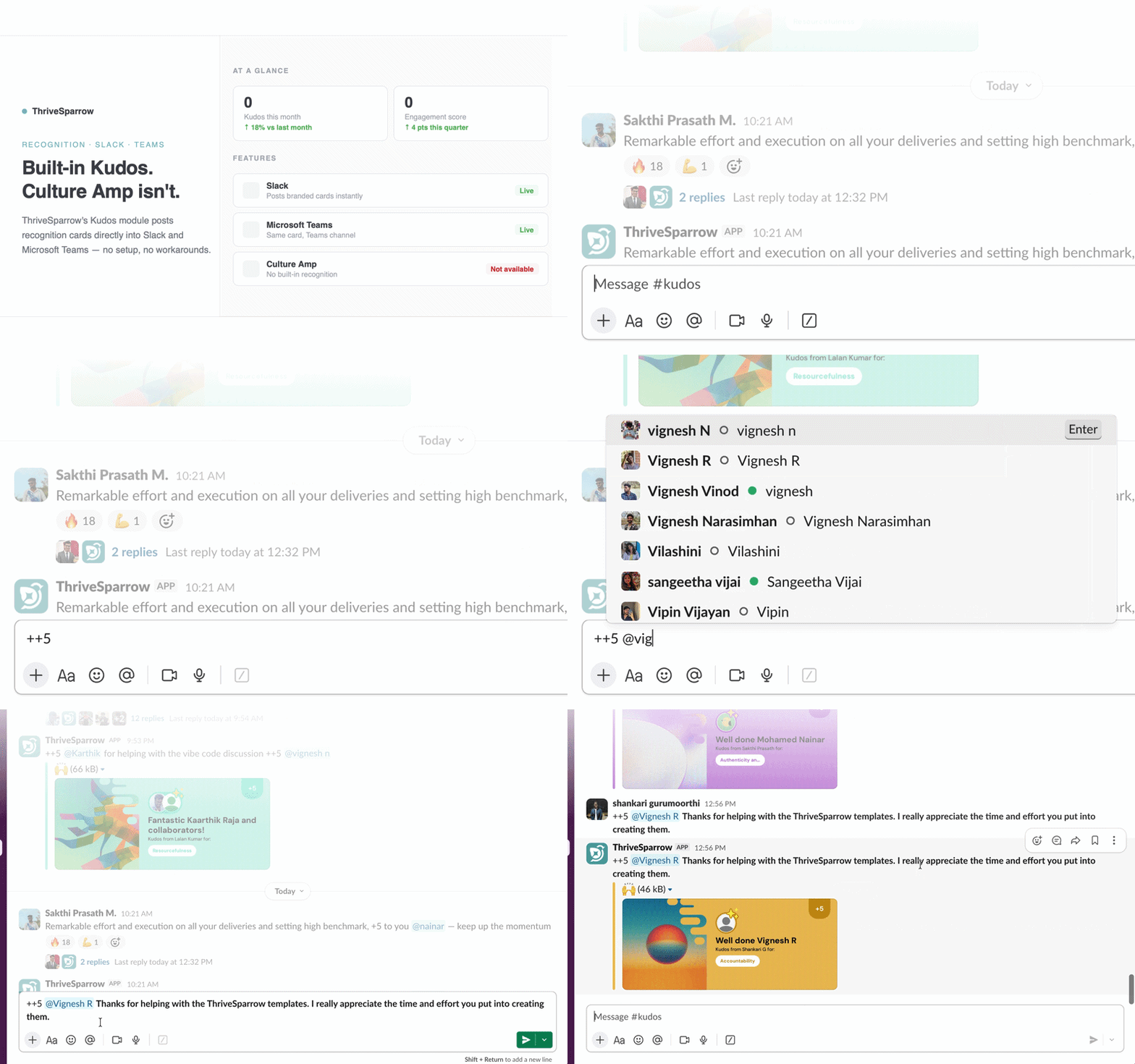
Kudos costs $2 per employee per month, and Engage + Kudos, which adds engagement surveys, costs $4 per employee per month, billed annually (see full pricing). To be clear about the trade-offs: we don't offer a Visa reward card or stipend accounts like Motivosity, and we offer a 14-day free trial rather than a permanent free plan like Bonusly's.
For a side-by-side look, see ThriveSparrow vs Bonusly.
Want recognition and engagement data in one place? Start a 14-day trial or book a demo to see how our Kudos works alongside pulse surveys and eNPS.

Frequently asked questions
1. What are the main alternatives to Bonusly and Motivosity?
Recognition-first alternatives include Nectar, Kudos, Awardco, Matter and Give River. Broader platforms such as ThriveSparrow combine recognition with surveys and performance reviews. Our guides to Bonusly alternatives and the best employee recognition software compare them in detail.
2. Can we use either tool without a rewards budget?
Yes. Bonusly lets companies leave paid rewards switched off and use no-cost custom rewards instead. Motivosity lets employees send recognition with or without a reward attached. You still pay for the software, including Motivosity's $3,000 minimum.